 Request A Quote
 Let's Talk
 Mail Us
 WhatsApp
“Free zone means tax-free.” Not anymore.
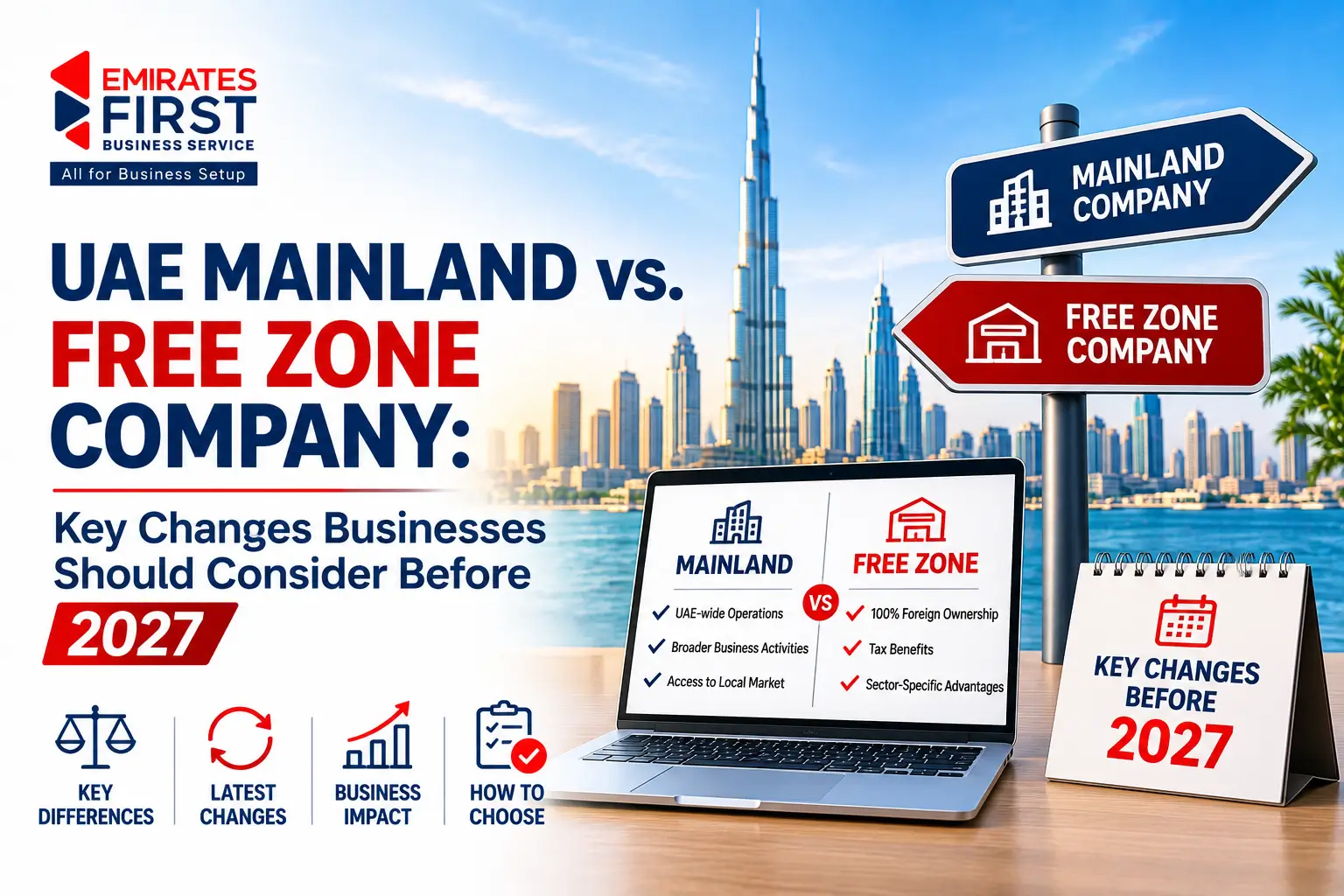
Are you confused about whether to set up a mainland vs. free zone company in UAE? Here is the short answer. A mainland company can trade across the UAE. A free zone company offers simpler setup and a possible 0% tax, but only on qualifying income. The right choice now depends on your tax status, customers, and compliance readiness. For years, free zones were the “tax-free” route. That idea is no longer safe. Four changes explain why: corporate tax, the end of Small Business Relief, free zone access to the Dubai mainland, and e-invoicing.
The main difference is where you can trade. A mainland license opens the whole UAE market. A free zone license is narrower.
| Mainland | Free zone | What has changed? | |
|---|---|---|---|
| Market access | Whole UAE, including government bodie | Inside the zone and outside the UAE | Dubai free zone firms can seek DET approval for the mainland. |
| Ownership | 100% foreign ownership in many activities | 100% foreign ownership | Mainland has opened up. Some activities have exceptions. |
| Licensing authority | DET in Dubai | Free zone authority | None |
| Office and visa | Office usually needed; visa quota linked to it | Flexi-desk options; quota depends on package. | Substance now matters for tax. |
| Corporate tax | 0% up to AED 375,000, then 9% | 0% on qualifying income only | Not automatically tax-free |
| Cost profile | Varies by activity, office, and visa | Varies by zone, package, and visas | Compare total cost. |
| Best suited to | Local customers, government work | Overseas clients, zone-based work | Hybrid setups are now possible. |
A mainland licence in Dubai comes from the Department of Economy and Tourism (DET). A free zone licence comes from the free zone authority. Want the full process? Read about mainland company formation or the Dubai Free Zone company route.
No. A free zone company is not automatically tax-free. On free zone vs mainland tax, the gap is now much smaller. The 0% rate applies only to qualifying income, and only while conditions are met.
Mainland companies pay 0% on taxable income up to AED 375,000 and 9% above that. This comes from Federal Decree-Law No. 47 of 2022. The Federal Tax Authority (FTA) also expects related party deals to follow transfer pricing rules.
A Qualifying Free Zone Person (QFZP) pays 0% on qualifying income only. All other income is taxed at 9%, with no AED 375,000 band. Cabinet Decision No. 100 of 2023 and Ministerial Decision No. 265 of 2023 set the conditions:
Income from mainland customers is generally non-qualifying, unless an exception applies. Large multinational groups may also face the 15% domestic minimum top-up tax, regardless of their free zone status. The Ministry of Finance (MoF) explains this on its website.
It can lose it by failing any condition. Under FTA guidance, a company that falls short loses QFZP status for that tax period and the next four. Missed deadlines also bring penalties, so read about late corporate tax penalties. For returns and registration, see corporate tax and VAT services.
Small Business Relief stops after tax periods ending on 31 December 2026. It lets an eligible resident business with revenue of AED 3 million or less be treated as having no taxable income. The rule sits in Ministerial Decision No. 73 of 2023, published by the MoF.
Small Business Relief ending 2026 matters most to new mainland startups. It is not available to a QFZP or to members of multinational groups. Check exact eligibility in the official text.
From 2027, the standard 0% and 9% structure applies, unless the MoF announces otherwise. Plan without an extension.
Electing the relief can also affect how tax losses are treated, so think before you choose. Confirm your eligibility and election steps on EmaraTax or with a qualified adviser.
Yes, in many cases, with DET approval. Dubai Executive Council Resolution No. 11 of 2025 lets free zone companies, except DIFC financial institutions, work in mainland Dubai. They need a DET license, branch, or temporary permit. Some call this a dual-license setup.
What this means for you:
The resolution covers Dubai only. Other emirates have their own rules. It also does not mean a free zone company can trade freely across the UAE. If you plan a business setup in Dubai through a zone, see the Dubai Free Zone company page.
It affects both structures equally. E-invoicing applies to eligible B2B and B2G transactions, whether you are on the mainland or in a free zone. So it is a compliance factor, not a deciding one.
| Stage | Timing |
|---|---|
| Pilot phase | From 1 July 2026 |
| Businesses with annual revenue of AED 50 million or more | Go-live: 1 January 2027 |
| All other in-scope businesses | Go-live 1 July 2027 |
Source: Ministry of Finance. Dates for appointing an accredited service provider differ across reports, so check the official MoF page.
Ministerial Decision No. 197 of 2026 amended parts of the framework. Read the official text for exact changes. B2C invoicing is not in scope unless the MoF confirms it. Check your accounting software and invoicing process with an accredited provider.
Five more points can shape your decision.
Need help with visas or paperwork? Try PRO services.
There is no single answer to which is better, mainland or free zone. It depends on your target customers, revenue mix, license activity, and substance.
| Business profile | May favor mainland | May favour free zone | What to confirm |
|---|---|---|---|
| Local service business | Direct access to UAE customers | Possible, but mainland income needs care | Tax on local revenue, scalability |
| Consultant with mostly overseas clients | Useful if local clients may grow | Often a natural fit | QFZP conditions, substance |
| Trading company | Wider local market | Suits export or zone-based trade | Activity on license, banking |
| Business seeking government or large corporate contracts | Buyers may prefer it. | May need extra permits | Tender rules, exit options |
A hybrid setup may also exist. That could be a free zone company with a DET branch or permit, or a mainland company alongside a free zone entity. It needs proper advice.
Start with this six-point UAE company compliance 2027 check before 31 December 2026:
For corporate tax registration and return deadlines, use the dates the FTA publishes on EmaraTax. If your structure no longer fits, company restructuring UAE options exist, such as company re-domiciliation.
No. A free zone company pays 0% only on qualifying income, and only while it meets the conditions. Other income is taxed at 9%.
Yes. They pay 0% on taxable income up to AED 375,000 and 9% above it. Small Business Relief may apply for periods ending on or before 31 December 2026.
In Dubai, often yes, with a DET licence, branch, or temporary permit. Mainland income is generally non-qualifying for tax. Other emirates have their own rules.
It ends. From 2027, the standard 0% and 9% structure applies, unless the MoF announces otherwise. No extension has been confirmed.
Yes. It applies to eligible B2B and B2G transactions for both structures. Go-live is 1 January 2027 for larger businesses and 1 July 2027 for others.
Often yes, through restructuring or re-domiciliation. The steps depend on your licence and activity, so get advice first.
Neither is always cheaper. Mainland vs. free zone cost depends on licence type, activity, visas, office or flexi-desk, audit, and renewals. A quotation depends on your setup.
The choice now rests on tax status, customers, and compliance readiness, not old assumptions.
Efirst (Emirates First Business Service LLC) is one of the Dubai business setup consultants that helps with company formation in Dubai. That covers mainland, free zone, and offshore setups, plus PRO, VAT, and related services.
Considering a mainland or free zone company before 2027? Get your structure checked before the year ends.
Book a structure consultation.
Disclaimer: This article gives general information only. It is not legal or tax advice. Rules change, so confirm details with official sources or a qualified adviser.




© 2026 Emirates First Business Service LLC. All Rights reserved.


