 Request A Quote
 Let's Talk
 Mail Us
 WhatsApp
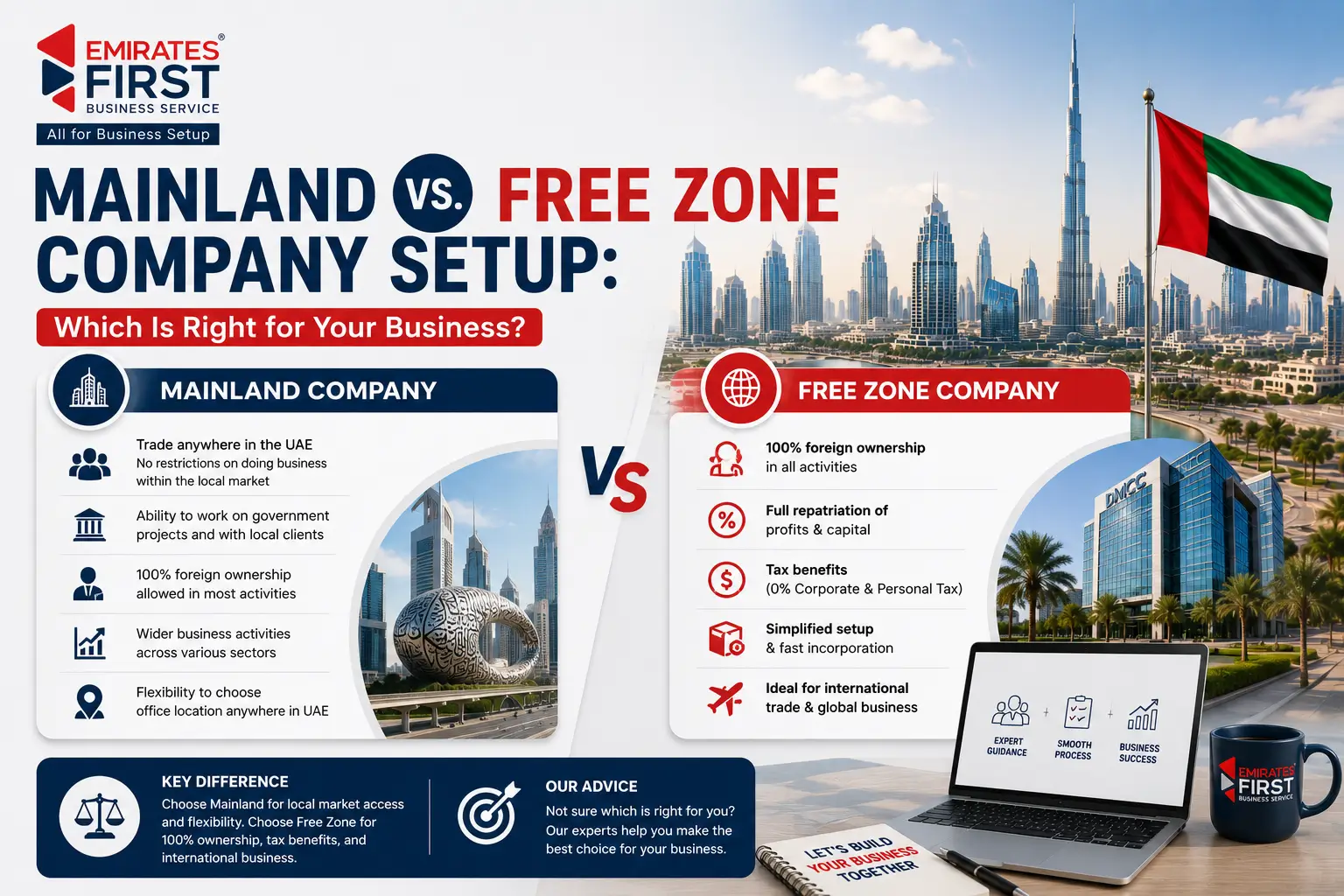
Table of Contents
Setting up a business in the UAE is one of the most exciting entrepreneurial decisions you can make, but it comes with a critical fork in the road: Mainland or Free Zone?
Both options have grown significantly in popularity, and with recent regulatory reforms reshaping the UAE business landscape, the lines between them are blurring. Yet the choice you make will define your market access, ownership structure, visa eligibility, and long-term growth potential.
At Emirates First (efirst.ae), we've helped thousands of entrepreneurs navigate this decision since 2017.
A mainland company formation in UAE refers to a business registered directly under the Department of Economic Development (DED) of the respective emirate. Mainland companies can operate freely anywhere within the UAE across all seven emirates and can also conduct business internationally. Historically, mainland setups required a UAE national to hold at least 51% ownership. However, following the UAE's landmark 2021 amendments to the Federal Commercial Companies Law, most business activities now allow 100% foreign ownership on the mainland, eliminating the need for a local Emirati partner in the majority of sectors.
📎 Source: Dubai Department of Economy & Tourism — det.gov.ae
A Dubai Free Zone Company Formation means registering your business within one of the UAE's designated economic zones, each governed by its own Free Zone Authority (FZA). The UAE currently hosts over 50 free zones catering to specific industries, with prominent examples including DMCC, JAFZA, Dubai Internet City, Dubai Silicon Oasis, and Dubai Media City. Free zones were specifically designed to attract foreign investment by offering a simplified, business-friendly regulatory environment with streamlined processes and compelling tax incentives.
📎 Source: UAE Ministry of Economy — economy.gov.ae
| Feature | Mainland | Free Zone |
|---|---|---|
| Foreign Ownership | Up to 100% (most sectors) | 100% always |
| UAE Market Access | Unrestricted | Via distributor only |
| Government Contracts | Yes | No |
| Office Requirement | Physical (min. 200 sq. ft.) | Flexi-desk / Virtual office |
| Visa Quotas | Flexible (office size-based) | Typically 1–6 per package |
| Multiple Branches | All emirates | Zone + international |
| Setup Cost (approx.) | From AED 19,999 | From AED 12,500 |
| Regulatory Authority | DED (per emirate) | Free Zone Authority (FZA) |
| Corporate Tax | 9% on profits > AED 375,000 | 0% (qualifying income) |
| Best For | Local market-focused | International / export-focused |
Sources: DET, Federal Tax Authority, DMCC
One of the most sought-after benefits of a Free Zone setup is the Dubai Free Zone Visa, a UAE residency visa issued through the free zone authority that allows business owners, employees, and their dependents to legally live and work in the UAE.
Several free zones have introduced tighter visa quota controls in 2025, requiring companies to demonstrate active operations or workforce necessity before receiving additional visa allocations. Companies working from flexi-desks should confirm current policies with their specific free zone authority before applying.
When deciding on your business setup in UAE, ask yourself these critical questions:
If you plan to sell directly to UAE residents, retail customers, or government entities, a mainland license gives you the freedom to do so without restrictions. Free zone companies selling into the UAE mainland must work through a local distributor or obtain a separate mainland license.
Both structures now allow 100% foreign ownership in most cases. However, if you're in a strategically sensitive sector (defense, oil & gas, banking, or telecommunications), mainland setups may still require UAE national involvement, while free zones retain full foreign ownership across the board.
If you're building a growing team, a mainland setup offers more flexible visa quotas linked to office square footage with no hard cap. Free zones can restrict quotas for flexi-desk users to just 1–3 visas, which can bottleneck hiring as your team grows.
Free zones are often more affordable to set up, especially for solo founders and startups, as virtual offices and flexi-desks eliminate the need for a physical office lease. Mainland setups require a minimum of 200 sq. ft. of physical office space, which adds to running costs.
Only mainland-registered companies are eligible to bid on UAE government and semi-government contracts. If your business model involves public sector work, the mainland is your only route.
Free zones were built for import/export and international business. With customs duty exemptions and international-facing infrastructure, especially zones like JAFZA near Jebel Ali Port, they offer a significant logistical edge for global traders.
Mainland is Better For
Free Zone is Better For
Absolutely. Many savvy entrepreneurs in the UAE operate with a dual structure: a free zone company for international operations and a mainland entity (or a commercial agency agreement) for UAE market access. This gives you the best of both worlds: the tax efficiency and full ownership of a free zone, combined with the unrestricted market access of a mainland license.
Pro Tip: A dual-entity strategy is especially popular among e-commerce businesses and trading companies that need both a cost-efficient operational base and direct access to the UAE's 3.3 million+ consumer market. Emirates First can structure a compliant, cost-effective dual setup for you.
Since 2017, Emirates First Business Services has assisted thousands of entrepreneurs with company formation across mainland and all major free zones in the UAE. Our services include:
Mainland setup from AED 19,999 includes Dubai Mainland Trade License, Memorandum of Association (MoA), Virtual Office / Ejari, and Establishment Card. Contact us at info@efirst.ae or call +971 50 347 2388.
A mainland company is registered with the DED and can operate freely anywhere in the UAE, including direct trade with the local market and government contracts. A free zone company is registered within a specific economic zone and offers 100% foreign ownership, tax advantages, and simplified setup but is restricted from direct trading in the UAE mainland without a local distributor or a separate mainland license.
Yes. Following the UAE's 2021 Commercial Companies Law amendments, foreign nationals can own 100% of a mainland company in most business activities. Exceptions apply to a limited number of strategically sensitive sectors such as defence, oil & gas, banking, and telecommunications, where UAE national participation may still be required.
The cost varies depending on the free zone, business activity, office package, and number of visas required. Entry-level free zone packages can start from approximately AED 12,500–15,000, while more comprehensive setups in premium free zones can range from AED 25,000 to AED 50,000 or more. Emirates First offers competitive packages across all major free zones; contact us for a tailored quote.
Visa quotas depend on your office package and the specific free zone's regulations. A flexi-desk package typically allows 1–3 visas, while a private office allows more. You can upgrade your workspace to increase your visa quota. As of 2025, several free zones also require proof of active business operations before approving additional visa allocations.
A free zone company cannot directly trade in the UAE mainland without either appointing a licensed local distributor or commercial agent or obtaining a separate mainland trade license. If mainland market access is a priority, it may be more practical to set up a mainland entity from the outset or opt for a dual-entity structure.
Free zone setups are generally more affordable at the outset, particularly because virtual office and flexi-desk options eliminate the need for a physical office. Mainland setups typically require a minimum physical office space of 200 sq. ft., adding to operational costs. However, long-term cost-effectiveness depends on your visa requirements, market strategy, and business scale.
Free zone company formation can often be completed within 3–7 business days. Mainland company formation typically takes 7–15 business days depending on the business activity, approvals required, and documentation. Emirates First offers expedited processing for both structures.
For most business activities, no. The 2021 amendments to the UAE Commercial Companies Law removed the 51% local ownership requirement for the majority of sectors. However, for certain restricted activities and for specific legal structures, a local service agent (not a shareholder) may still be required. Our consultants at efirst.ae can advise based on your specific activity.
The UAE introduced a 9% corporate tax applicable to businesses with taxable income exceeding AED 375,000 annually. Free zone companies may qualify for a 0% preferential tax rate on qualifying income, provided they meet substance requirements and do not derive income from UAE mainland sources. Tax structuring should always be done with professional guidance.
You cannot directly convert a free zone company into a mainland entity. However, you can establish a separate mainland company or branch alongside your existing free zone entity. Emirates First can advise on the most efficient transition or dual-structure strategy for your specific business situation.




© 2026 Emirates First Business Service LLC. All Rights reserved.


